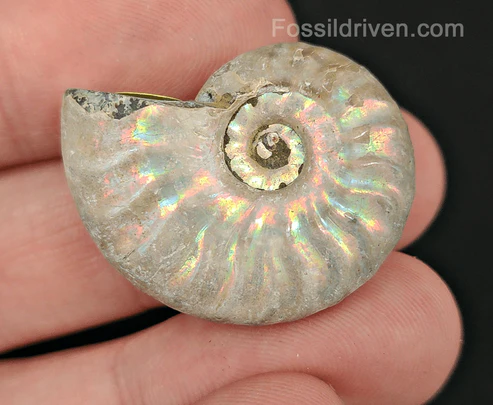
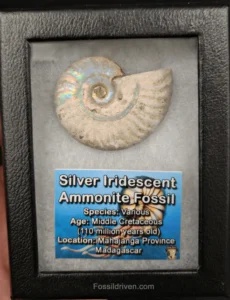
Be captivated by the glimmering allure of our Silver Iridescent Ammonite range: real, gently preserved shells from the Middle Cretaceous (about 110 million years ago) of Mahajanga Province, Madagascar. These are the ones known for their natural carbonate that vividly changes color from silver, rainbow, and opalescent – a rare optical phenomenon that, in effect, makes every single one of these a tiny jewel traveling through time. Collected ethically and prepared thoroughly, these spiral shells are a direct link to the ancient oceans and, therefore, great additions to the collections of Geologists, Educators, or the general public who happen to be lovers of rare gifts of the out-of-the-blue past.
Why these fossils shine — and why they matter
Ammonoids were marine cephalopods that existed for hundreds of millions of years; their coiled shells are commonly found as fossils, but only a very small number of them have that wonderful pearly layer preserved. What distinguishes our pieces from others is not only the preserved nacre — the same kind of structural shine that is seen on high-quality pearls and some mollusk shells — but also the resultant iridescence that changes with the angle and light. This is the wisdom behind the desire of a collector for an iridescent ammonite: a collection specimen is a one-of-a-kind showcase of optical physics and biological architecture. These fossils, besides their alluring appearance, are crucial to science. They are to paleontologists’ aid in reconstructing the ancient marine worlds, refining biostratigraphy (dating of sedimentary layers), and even studying evolutionary trends of the cephalopods. These ammonoids fossi come from Mahajanga, a place well known for the quality of the fossils preserved there; thus, they provide significant duo aesthetic and scientific research value.
How we prepare, preserve, and present each specimen
Each shell in our range is done with utmost moral principles: adherence to local regulatory measures is ensured, and preparators who are professionals carefully detach the matrix, extend the life of the delicate parts through consolidants, and keep the natural spiral shape intact. The development of the shell into a specimen is a challenging task — if the work is too aggressive, the nacre will be harmed; if it is too cautious, the detail will be left undiscovered. We put a great emphasis on perfect harmony between preservation and projection in our performance: every ammonite is secured with archival-grade materials and brought to a state where the iridescent parts, along with the inner chamber detail, can be seen without the fossil’s strength being compromised. Furthermore, we document the origin-place, stratigraphic context, and approximate age – so that the buyers, educators, and researchers can see it as a medium of communication in addition to being a story and substance.
Caring for your iridescent ammonite — display tips
To maintain that pearly shine strong, keep and exhibit the items in a place where they are safe from direct sunlight and are not too humid. A soft microfiber cloth and mild dusting would generally suffice if you intend to clean the specimen; do not use chemicals from the kitchen.
Put them in a place where the light is soft and from diffused LED bulbs if you want to highlight the silver and the rainbow flashes, and at the same time, not heat the fossils. In the educational world, placing a specimen along with a laminated note describing the Middle Cretaceous context (~110 million years ago), ammonoid biology, and how nacreous iridescence forms is not just an instant conversation starter but also a blending of art and science.
Conclusion
Our Ammonite pieces in silver with iridescence are not simply fossilized remains — they are frozen moments of the oceanic past that nature took its time polishing them into miniature masterpieces of living color. So, whether you are a collector looking for a spectacular piece for your collection, a teacher in search of an intriguing artifact for the classroom, or a gift giver out of curiosity and wanting something rare and meaningful, these fossil specimens of ammonoids, sourced ethically and prepared professionally, are a bridge between miracle and science. Each of those spirals is a tale of the sea long gone and the slow mineral change — a little silver-lit glimpse into Earth’s far past. Interested in purchasing one for your collection or finding out more about a particular piece? It is my pleasure to assist you in selecting the piece that best fits your needs and wants.
About the Author